
What Does a Business Operations Partner Actually Do?
The GOLDSPUN Method Explained
You have successfully become the most overqualified admin assistant your business has ever had.
I say that with love, because I've been there myself, and because it's the sentence that describes almost every founder I sit down with for the first time. Smart, capable, driven, and quietly buried under a version of their own business that was never supposed to need them for absolutely everything.
People ask me what a Business Operations Partner actually does, and it's a fair question, because the job title doesn't explain itself the way "virtual assistant" does. So here it is, properly. I work to a method I built called GOLDSPUN, eight stages, one for each letter of the name, and it's the same process every client goes through, whether we're together for three months or three years.
Let me walk you through it, and I'll bring a real client along with us, anonymised, but the pattern will be familiar to a lot of you reading this.
She'd left a corporate career to start her own coaching business. Fifteen years of operational experience behind her, genuinely excellent at her craft, and completely drowning six months in. She'd hired a VA before, eight hours a month, and it fell apart within weeks. Not because the VA was bad, but because nobody had ever mapped out what actually needed doing, so the VA sat waiting to be told, and she was too underwater to do the telling. That's where we started.
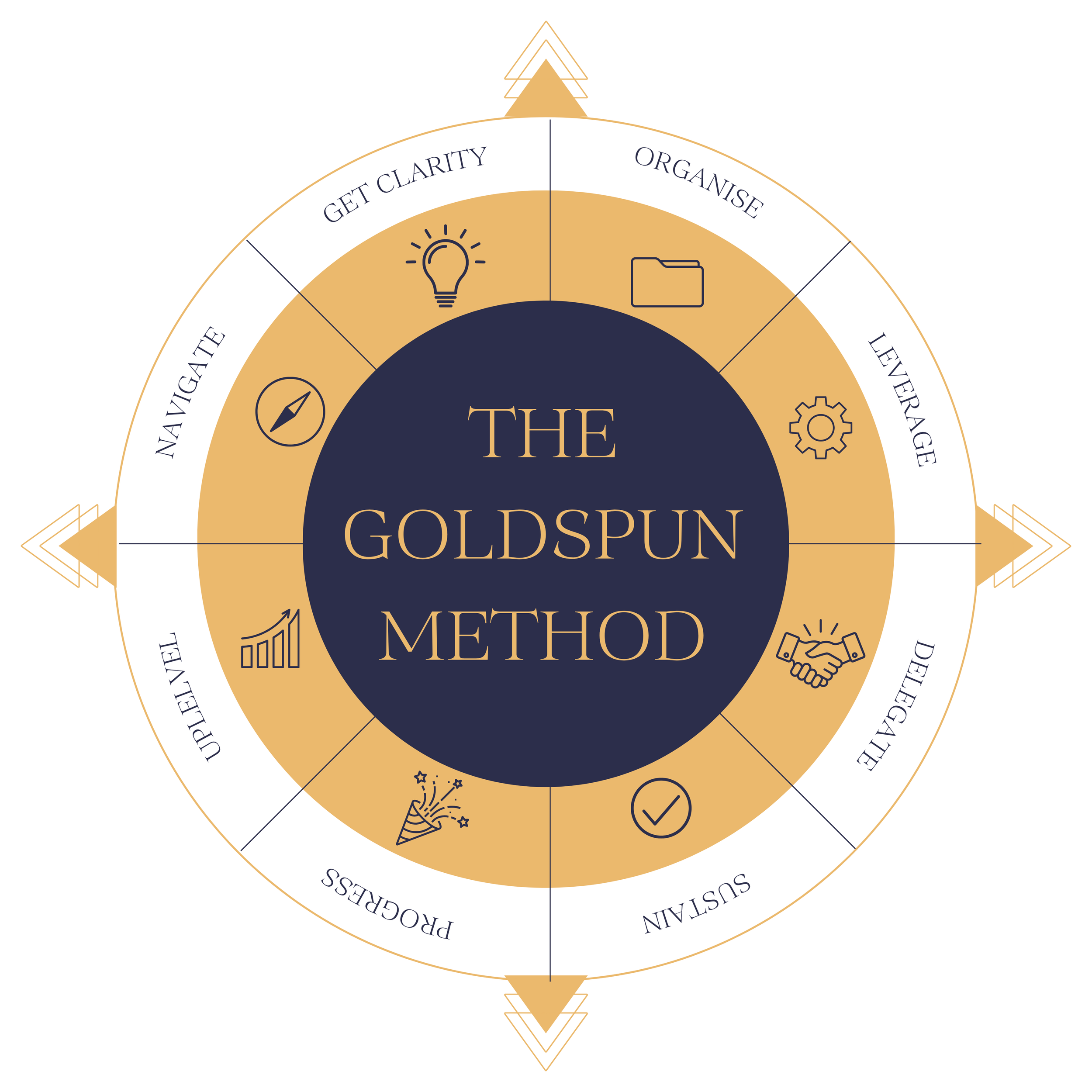
G — Gauge
Before anything else, we work out exactly where you are. Current systems, current capacity, where the pressure is actually coming from, what's working, what's held together with sheer willpower, and what's about to break. This is the diagnostic stage. Honest, specific, no assumptions.
For her, this meant looking at her inbox, her half-set-up email tool, and the eight subscribers on a list she hadn't touched in months. It wasn't that she lacked ideas. She had plenty. She simply had no visibility on what was urgent versus what was just loud.
O — Organise
Structure before systems. We organise the operational architecture, how information flows, how decisions get tracked, how the day to day actually holds together, before we build anything on top of it. There's no point automating a mess. You'll just have a faster mess.
For her, this meant a simple, unglamorous first step: getting her inbox to a place where nothing important was slipping through, and building an actual structure for her email list before a single campaign got written.
L — Leverage
Too many operations overhauls throw the baby out with the bathwater. We look at what's already working, her instincts, her relationships, the parts of the business that were genuinely solid, and build on those rather than starting from nothing. She already had strong client relationships and a clear sense of who she served. That didn't need fixing. It needed protecting and building on.
D — Delegate
This is the stage most people think the whole job is, and it's only one part of eight. We work out, properly, what should stay with you and what shouldn't. Most founders are doing things that don't need their expertise, and not doing the things that do. Delegation here is strategic, not just "here's a pile of tasks, off you go."
For her, that meant her time went back into coaching and content, the things only she could do, while the email management and list-building moved to me.
S — Sustain
Systems that only work when you're paying very close attention aren't systems, they're good intentions with a deadline. Sustain means building for an average week, not just the good ones. This is the stage a lot of task-based help skips entirely, because nobody was ever asked to think past this week's to-do list.
P — Progress
We track what actually matters, not vanity numbers that feel good and mean nothing. For her, that meant watching whether the list was growing and warming up, not just whether emails were going out. Progress means you can see your own trajectory and make decisions from evidence, not from a gut feeling at eleven at night.
U — Uplevel
Once the foundations are solid, we build up from there. More capacity, an expanded offer, higher rates, whatever the next stage genuinely calls for. Uplevel only works from a stable base. Trying to scale on top of chaos just gets you louder chaos.
For her, uplevel looked like moving from "keep the lights on" support into an actual content and lead generation plan, funnel, lead magnet, warm outreach, once the basics were finally solid enough to build on.
N — Navigate
The ongoing compass. Operations isn't a once and done fix, it's a continuous function. Navigate means staying oriented as the business grows and changes, adjusting the structure to match where things are heading rather than where they used to be. This is the stage that never really finishes, because a growing business never stops needing recalibration.
Why it works in that order
Every stage before Delegate exists so that delegation actually works when it finally happens. That's the piece that gets skipped when someone hires task-based help straight off the bat. You end up handing tasks into a business that was never gauged, never organised, with nobody having worked out what to leverage or what genuinely needs sustaining.
That's the difference between a VA and a Business Operations Partner in one sentence: a VA starts at Delegate. A Business Operations Partner starts at Gauge, and only delegates once there's something solid to delegate into.
Where to start
If you recognise yourself somewhere in this, the overqualified admin assistant, the founder still doing everything because nobody's ever mapped what shouldn't be on your plate, that's exactly what Gauge is for. It's not a sales pitch dressed up as a framework. It's the actual first conversation, the one that finds out what's really going on before anyone decides what happens next.